> For the complete documentation index, see [llms.txt](https://help.depence.com/llms.txt). Markdown versions of documentation pages are available by appending `.md` to page URLs; this page is available as [Markdown](https://help.depence.com/depence-construction/object-extensions/reflector.md).
# Reflector
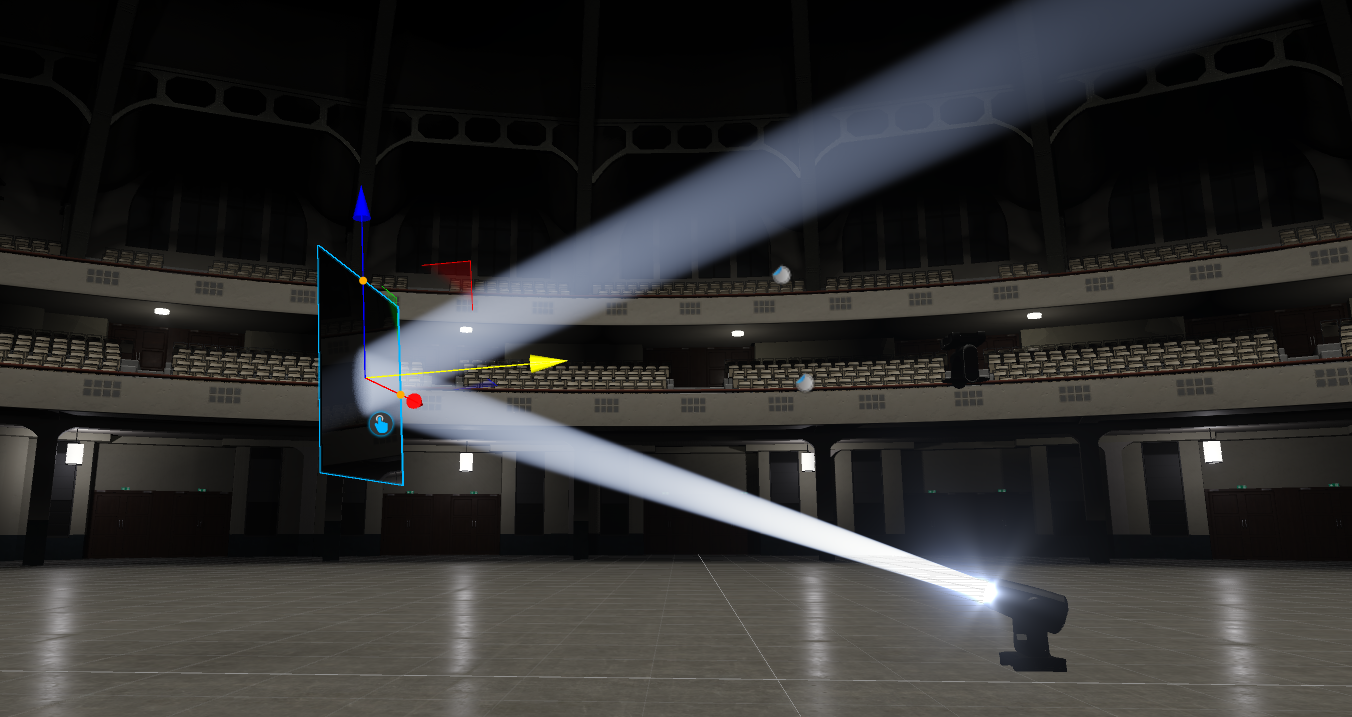
The **Reflector** extension empowers you to configure reflection settings on a mesh, enabling both planar reflections and bounce lighting effects:
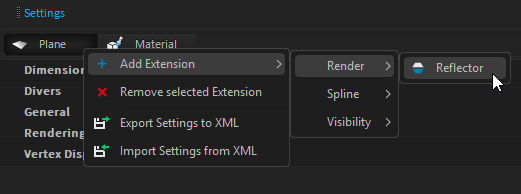
Add Extension > Render > Reflector
## Planar Reflection
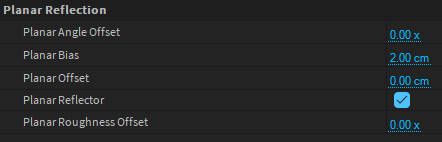
This option enables a reflection plane, which renders the entire scene again from a mirrored perspective and mapped onto the surface. This creates a realistic reflection effect.
Planar Reflection settings
{% hint style="info" %}
This only works on flat and even surfaces
{% endhint %}
### Fresnel
The Fresnel value restricts the visibility of the reflection based on the viewing angle relative to the surface.
Example Material: Diffuse Color (0,0,0), Metalness 100%, Roughness 0% -- Fresnel 1,7x
### Planar Bias
This value creates a small bias offset to avoid z-fighting and flickering in far distances
### Planar Offset
The reflection axis is aligned with the origin of the 3D model object. When applying planar reflection, for example, on a cube, the reflection axis can be adjusted using the planar offset.
### Planar Roughness Offset
The planar reflection is blurred based on the material's roughness. This behavior is not always desired and can be adjusted here without modifying the material itself.
## Bounce Lights
With this option, it is possible for a light beam or laser to be reflected. This can be enabled separately for spotlights and lasers.
Bounce Light settings
{% hint style="danger" %}
This option creates an additional light source for each reflector. This can be very performance-intensive!
{% endhint %}
{% hint style="warning" %}
For bounce lights to work, the shadow quality must be set higher than Low! Also the Cast-Shadow option of the model itself must be active.
{% endhint %}
### Multi-Bounces
Multiple Bounces are only possibe for Lasers *(no projections)*. To enable this, select the Laser-Fixture and look for the child "Laser" object. Here you will find the properties "Max Reflection Bounces" and "Trace Reflections". These define when and how much bounces are supported. Max 4 are allowed.
### **Limitations**
* Bounce lights do not trace shadows.
* Objects positioned between the light source and the mirror block the direct light cone but still emit a bounce light.
* Multi-bounces are only possible with lasers (beam only)
* This only works on flat surfaces
---
# Agent Instructions
This documentation is published with GitBook. GitBook is the documentation platform designed so that both humans and AI agents can read, navigate, and reason over technical content effectively. Learn more at gitbook.com.
## Querying This Documentation
If you need additional information that is not directly available in this page, you can query the documentation dynamically by asking a question.
Perform an HTTP GET request on the current page URL with the `ask` query parameter, and the optional `goal` query parameter:
```
GET https://help.depence.com/depence-construction/object-extensions/reflector.md?ask=&goal=
```
`ask` is the immediate question: it should be specific, self-contained, and written in natural language.
`goal` is optional and describes the broader end goal you are ultimately trying to accomplish on behalf of the user. GitBook uses it to tailor the answer towards what is most useful for that goal.
The response will contain a direct answer to the question and relevant excerpts and sources from the documentation.
Use this mechanism when the answer is not explicitly present in the current page, you need clarification or additional context, or you want to retrieve related documentation sections.