> For the complete documentation index, see [llms.txt](https://help.depence.com/llms.txt). Markdown versions of documentation pages are available by appending `.md` to page URLs; this page is available as [Markdown](https://help.depence.com/depence-rendering/depence-image-rendering.md).
# Image Rendering
Depence offers high-quality image rendering in up to 8K\* resolution. To render your current Scene as an image navigate to the **Main menu** > **Rendering** > **Render Image...**

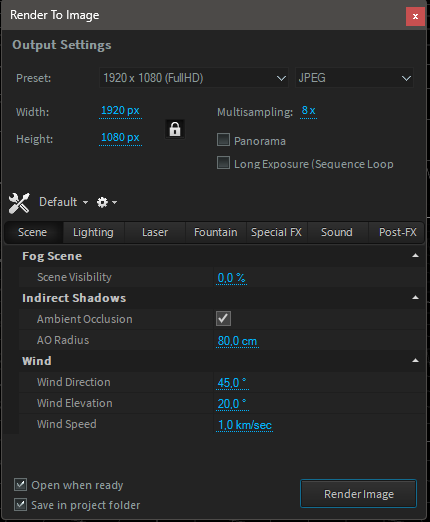
With the Width & Height settings, you can define the target resolution of your image, which can be also selected from the Presets list. The dialog also gives quick access to the current Render Settings.
{% hint style="danger" %}
Please note, that the maximum resolution may depend on your graphics hardware and available video memory! The rendering will force the engine to resize all its internal image buffers (which are a lot) to the target resolution, which can easily reach several GB in storage.
{% endhint %}
### **Output file**
The output type can be defined next to the resolution. If "Save in project folder" is checked, it will save the image automatically into the project folder's "Renders" folder, otherwise a save dialog will appear.
### **Multisampling**
Multisampling is the most performance/quality related option. It defines how often each pixel will be computed to render high-quality anti-aliasing and detailed light beams. Please note, that a Multisample factor of 8x might also multiply the time to render by 8.
### Panorama Rendering
The Panorama option will render a 360° spherical mapped image. This can be used for VR applications.
###
---
# Agent Instructions
This documentation is published with GitBook. GitBook is the documentation platform designed so that both humans and AI agents can read, navigate, and reason over technical content effectively. Learn more at gitbook.com.
## Querying This Documentation
If you need additional information that is not directly available in this page, you can query the documentation by asking a question.
Perform an HTTP GET request on the following URL with the `ask` and `goal` query parameters:
```
GET https://help.depence.com/depence-rendering/depence-image-rendering.md?ask=&goal=
```
`ask` is the immediate question: it should be specific, self-contained, and written in natural language.
`goal` is what the user is ultimately trying to achieve, the reason they need the answer. Sharing it helps GitBook give you a better, more relevant answer. A goal is most helpful when it describes the outcome the user wants rather than restating the question. For example, with `ask=how do I create an API token`, a goal like `automate deployments from our CI pipeline` lets GitBook tailor the answer to that use case.
The response will contain a direct answer to the question and relevant excerpts and sources from the documentation.
Use this mechanism when the answer is not explicitly present in the current page, you need clarification or additional context, or you want to retrieve related documentation sections.