> For the complete documentation index, see [llms.txt](https://help.depence.com/llms.txt). Markdown versions of documentation pages are available by appending `.md` to page URLs; this page is available as [Markdown](https://help.depence.com/depence-rendering/depence-video-rendering/depence-render-image-sequence.md).
# Render Image Sequence
Once you have selected JPEG, PNG, or BMP as the target file format, the engine will render all frames to individual image files with a frame-number suffix on the timeline.\
The best option in terms of image quality and rendering speed is JPEG, which will be stored with 100% compression quality (so nearly lossless).
Once you have rendered the image sequence, you will find the files in your target folder:

## **Import Image-Sequence in Adobe Premiere**
Especially for post-production, these image sequences are perfectly fitting, as you won't need to re-compress the material a second time. To correctly import an image sequence in Adobe Premiere see the following steps:
1. In Premiere go to File > Import..
2. Navigate to your path and select the first image of the sequence and check "Image Sequence".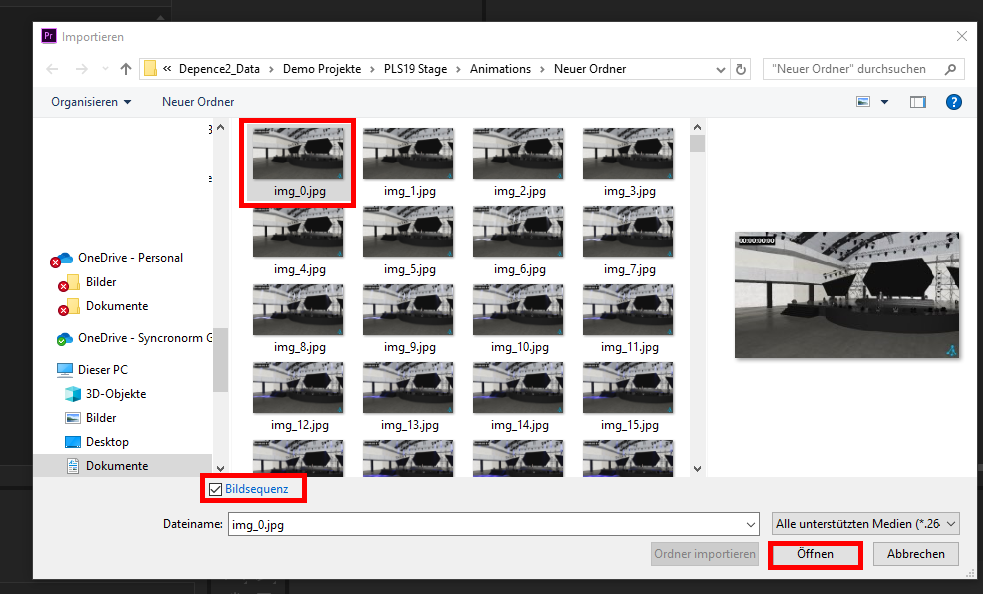 3. Right-click on the new Item in your project browser and go to Adjust > Interpret...
4. Now you would need to define the frame rate for the Image Sequence, which was initially used for rendering in Depence.

---
# Agent Instructions
This documentation is published with GitBook. GitBook is the documentation platform designed so that both humans and AI agents can read, navigate, and reason over technical content effectively. Learn more at gitbook.com.
## Querying This Documentation
If you need additional information that is not directly available in this page, you can query the documentation dynamically by asking a question.
Perform an HTTP GET request on the current page URL with the `ask` query parameter, and the optional `goal` query parameter:
```
GET https://help.depence.com/depence-rendering/depence-video-rendering/depence-render-image-sequence.md?ask=&goal=
```
`ask` is the immediate question: it should be specific, self-contained, and written in natural language.
`goal` is optional and describes the broader end goal you are ultimately trying to accomplish on behalf of the user. GitBook uses it to tailor the answer towards what is most useful for that goal.
The response will contain a direct answer to the question and relevant excerpts and sources from the documentation.
Use this mechanism when the answer is not explicitly present in the current page, you need clarification or additional context, or you want to retrieve related documentation sections.
3. Right-click on the new Item in your project browser and go to Adjust > Interpret...
4. Now you would need to define the frame rate for the Image Sequence, which was initially used for rendering in Depence.

---
# Agent Instructions
This documentation is published with GitBook. GitBook is the documentation platform designed so that both humans and AI agents can read, navigate, and reason over technical content effectively. Learn more at gitbook.com.
## Querying This Documentation
If you need additional information that is not directly available in this page, you can query the documentation dynamically by asking a question.
Perform an HTTP GET request on the current page URL with the `ask` query parameter, and the optional `goal` query parameter:
```
GET https://help.depence.com/depence-rendering/depence-video-rendering/depence-render-image-sequence.md?ask=&goal=
```
`ask` is the immediate question: it should be specific, self-contained, and written in natural language.
`goal` is optional and describes the broader end goal you are ultimately trying to accomplish on behalf of the user. GitBook uses it to tailor the answer towards what is most useful for that goal.
The response will contain a direct answer to the question and relevant excerpts and sources from the documentation.
Use this mechanism when the answer is not explicitly present in the current page, you need clarification or additional context, or you want to retrieve related documentation sections.