> For the complete documentation index, see [llms.txt](https://help.depence.com/llms.txt). Markdown versions of documentation pages are available by appending `.md` to page URLs; this page is available as [Markdown](https://help.depence.com/depence-hardware/depence-connect-a-console.md).
# Connect a Console
To connect Depence to a console via ArtNet / sACN, go to the Hardware workspace.

Next, press the + sign and then select "Visualizer" from the following list.

Select the ArtNet Input tab.
Depence supports ArtNET, sACN, an ethernet-based DMX network protocol. This allows you to control the visualization with any ArtNET / sACN compatible lighting console.
## **To enable ArtNET /** sACN **Input:**
1. Setup your Console to send ArtNET / sACN to the Computer with Depence running on. It's always recommended to send Unicast instead of Broadcast.
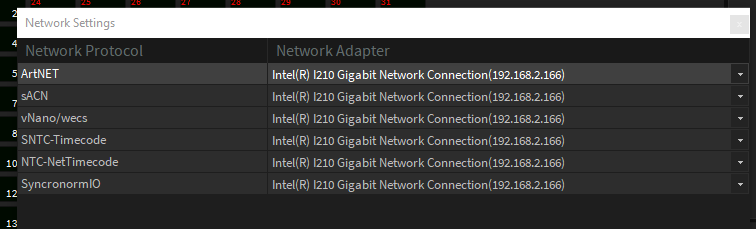
2. Make sure Depence uses the correct Network Adapter that's connected with your console. (Settings > Network Settings)
### Important: New in Depence 4.1
Starting with **Depence 4.1**, Art-Net, sACN, and CITP data are received and configured through the **LogicModule**.
This new workflow completes the network DMX concept and allows DMX universes to be received in separate, segmented universe ranges.
In previous versions, it was only possible to receive a continuous range of DMX universes, for example Universe 0 through Universe 1024. With Depence 4.1, multiple independent universe ranges can now be configured.
For example:
* Receive Universes 1–50
* Receive Universes 12500–12600
* Receive additional universe ranges as required
The **LogicModule** now provides dedicated receiver modules for the supported DMX network protocols. These modules can be found under:
**Network DMX**
When a new project is created, receiver modules for **Art-Net**, **sACN**, and **CITP** are already preconfigured. Depending on the protocols required for the project, the corresponding receiver modules only need to be enabled.
This provides greater flexibility, especially for large installations or network environments in which DMX universes are distributed across multiple, non-contiguous universe ranges.
#### Art-Net Receiver Module Settings
#### Example of Segmented DMX Reception
The image shows a segmented Art-Net configuration receiving the following universe ranges:
* Art-Net Universes 0–15
* Art-Net Universes 2100–2227
This allows multiple, non-contiguous DMX universe ranges to be received within the same project.
#### DMX View and Universe Activity
The **DMX Universe Activity** display has now been integrated into the **DMX View**. This combined view provides additional options for monitoring incoming DMX universes.
**Show Universes**
When **Show Universes** is enabled, the IDs of all incoming DMX universes are displayed.
**Only Activity**
When **Only Activity** is enabled in addition to **Show Universes**, only universes in which DMX values are currently changing are displayed.
This makes it easier to identify active universes, especially in larger installations with a high number of incoming DMX streams.
#### Display of All Received Universe Numbers
#### Display of Active Universe Numbers
---
# Agent Instructions
This documentation is published with GitBook. GitBook is the documentation platform designed so that both humans and AI agents can read, navigate, and reason over technical content effectively. Learn more at gitbook.com.
## Querying This Documentation
If you need additional information that is not directly available in this page, you can query the documentation by asking a question.
Perform an HTTP GET request on the following URL with the `ask` and `goal` query parameters:
```
GET https://help.depence.com/depence-hardware/depence-connect-a-console.md?ask=&goal=
```
`ask` is the immediate question: it should be specific, self-contained, and written in natural language.
`goal` is what the user is ultimately trying to achieve, the reason they need the answer. Sharing it helps GitBook give you a better, more relevant answer. A goal is most helpful when it describes the outcome the user wants rather than restating the question. For example, with `ask=how do I create an API token`, a goal like `automate deployments from our CI pipeline` lets GitBook tailor the answer to that use case.
The response will contain a direct answer to the question and relevant excerpts and sources from the documentation.
Use this mechanism when the answer is not explicitly present in the current page, you need clarification or additional context, or you want to retrieve related documentation sections.